
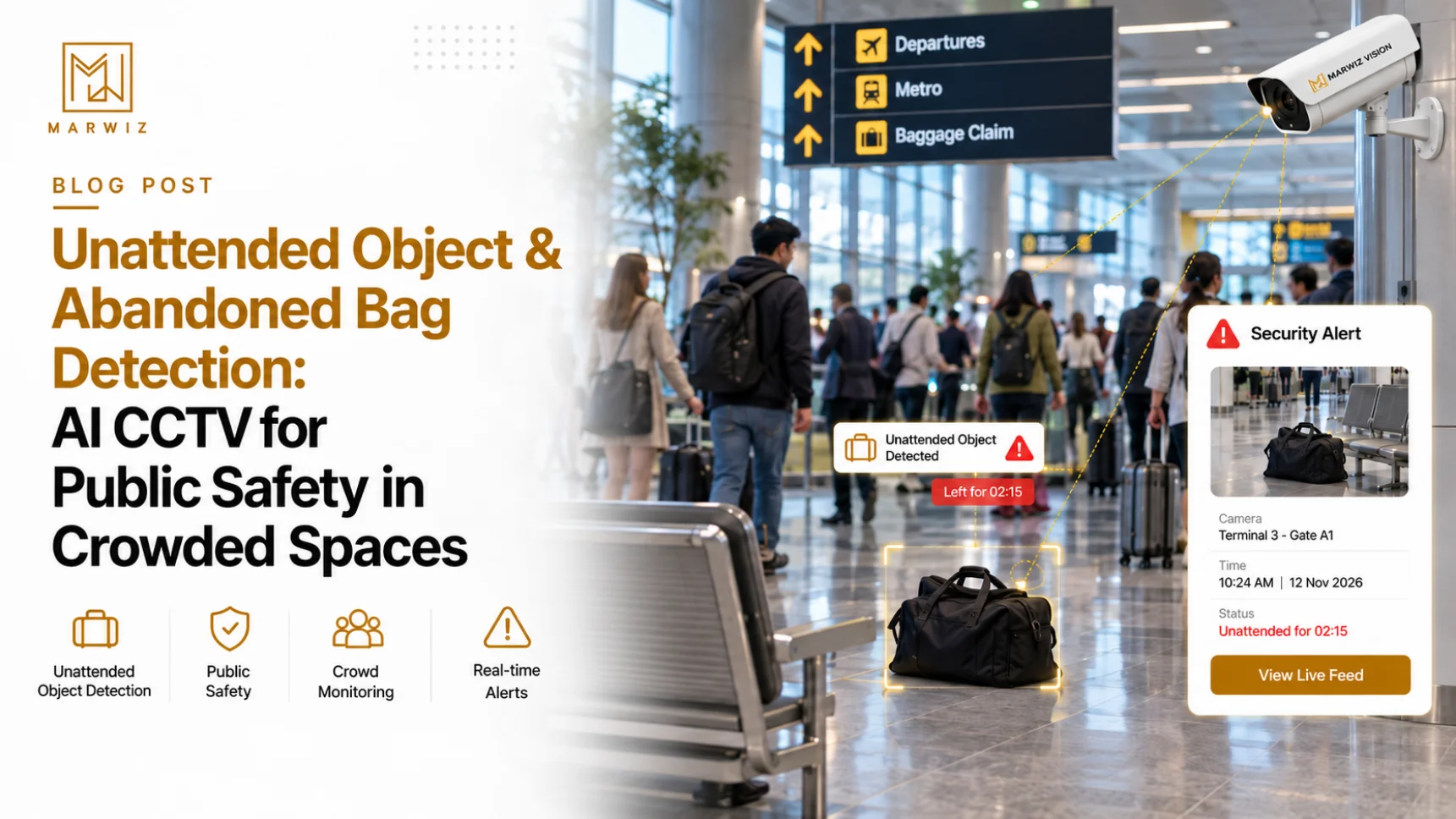
In November 2019, a bag left outside Terminal 3 of Delhi's Indira Gandhi International Airport triggered a full security alert on suspicion it contained explosives. Officials later confirmed the bag only held a laptop, its charger, some toys, and clothes, and that the traveler had simply forgotten it while traveling with a group of four. The passenger only came forward after more than sixteen hours had passed. Nothing dangerous was inside, but for sixteen hours, nobody knew that. This is the exact gap unattended object detection is built to close: not by replacing security protocol, but by cutting the sixteen-hour discovery window down to sixteen seconds. business-standardbusiness-standard
Who Currently Handles This in India — and Where the Gap Is?
The Central Industrial Security Force is India's primary multi-skilled security agency, mandated to protect critical infrastructure across sectors as diverse as aviation, shipping, and coal. Its personnel patrol airports, metro networks, and government buildings, physically scanning for exactly this kind of risk. Delhi Metro alone moves lakhs of commuters through its network every single day, and CISF's presence there stretches well beyond baggage, the force is regularly involved in recovering lost valuables, reuniting separated children with families, and stepping in for commuters in distress. businesstravelleraajtak
That is an enormous mandate for a finite number of personnel walking a finite number of platforms. A bag can sit still for ten or fifteen minutes in a crowded concourse before a patrolling officer happens to pass that exact spot again, and in a shopping mall, corporate lobby, or private hospital, there is often no CISF-equivalent presence at all. The responsibility falls entirely on general security guards watching a wall of monitors, where a stationary bag among hundreds of moving people is one of the easiest things to miss.
How AI Unattended Object Detection Actually Works?
The system runs on the IP cameras already installed at entrances, lobbies, platforms, and concourses, no new hardware required. It works in three continuous steps:
- Object-person association - the AI identifies every bag, box, or package as it enters the frame and links it to the person carrying it.
- Proximity and time tracking - if that person moves beyond a configured distance from the object and stays away past a set threshold (commonly two to five minutes, adjustable per site), the object is flagged as unattended.
- Instant escalation - security receives an alert within seconds, with the exact camera, location, and a snapshot of the object and the moment it was left not a report generated after a scheduled sweep.
Traditional Monitoring vs. AI-Powered Detection
| Factor | Manual Patrol / CCTV Recording | AI Unattended Object Detection |
|---|---|---|
| Detection speed | Depends on next patrol pass or a bystander noticing | Seconds after the object is left behind |
| Coverage | Limited to staffed checkpoints and patrol routes | Every connected camera, continuously |
| Evidence | Reviewed after the fact, if at all | Timestamped snapshot generated at the moment of the event |
| Staffing dependency | High needs constant human attention on every screen | Low staff act only when alerted |
| Consistency | Varies with shift, fatigue, and crowd volume | Constant, regardless of crowd size or time of day |
Where This Technology Delivers the Most Value?
| Check | What to Ask Your Vendor |
|---|---|
| Certification | Is the camera/device STQC-certified? STQC certification for internet-connected CCTV devices became mandatory in India from April 1, 2026, with testing and vulnerability-assessment obligations attached. |
| Data handling | How long is footage of a flagged object retained, and where is it stored? |
| Legal basis | Does the vendor's data practice align with India's Digital Data Protection framework? India's Digital Data Protection Act, passed in 2023, established a dedicated Data Protection Board and enforcement mechanism comparable to the EU's GDPR, with provisions that can apply even to data handling outside India. |
| Threshold configuration | Can the "unattended" time window be adjusted per zone, a 30-second threshold near a boarding gate versus 5 minutes in a mall food court? |
| Integration | Does it work with your existing IP cameras, or does it require new hardware? |
| Alert routing | Does the alert reach a named person or team within seconds, with a location and image attached? |
From a Sixteen-Hour Gap to a Sixteen-Second Alert
The Delhi airport incident ended safely, but it exposed exactly how long a genuine gap in visibility can stretch when detection depends on someone happening to notice, or a passenger happening to come forward. AI unattended object detection doesn't replace the CISF officer on the platform or the security guard in the lobby, it gives them the one thing neither currently has: a system that never stops watching the bag nobody's watching. As part of Marwiz Vision's broader public safety suite, this sits alongside loitering and restricted-zone detection inside one dashboard, so a flagged bag, a lingering figure, and a breached zone all show up in the same place — not across three different systems nobody has time to check.